
Donated instruments
Robert Bensted-Smith (Cambridge, England)
The microscope presented below was kindly donated by Robert Bensted-Smith, of Cambridge, England, in February 2026. I am most grateful for his generous contribution to the collection.


Microscope 604
(James Swift; Binocular microscope for conventional and polarized light microscopy; 1870s)
Microscope 604 is a binocular instrument designed for both conventional and polarised-light microscopy. It is engraved J. Swift, Optician, 43 University St, London WC and should probably be dated to the 1870s (Figure 1). The nosepiece incorporates both a Nicol prism and a Wenham prism, each housed in a separate sliding brass box, allowing the instrument to be used for polarised-light microscopy. It is also equipped with an achromatic substage condenser (Figure 1).
A Swift catalogue from the 1870s describes this condenser as follows: “...is a perfect substitute, at a moderate cost, for many pieces of apparatus essential to microscopes of a superior order... It comprises an achromatic combination of 90º aperture, available with all powers up to 1/3 in., tinted glass for neutralising the yellow rays of artificial light, focussing adjustment, dark ground illuminator, large diaphragm with rotating tube to carry wheel of apertures, polarising prism with two selenite films, clear aperture, and oblique light shutter for low powers.” This description highlights the versatility of the condenser, which combined several optical accessories and illumination arrangements in a single substage assembly, providing capabilities normally associated with more sophisticated microscopes.
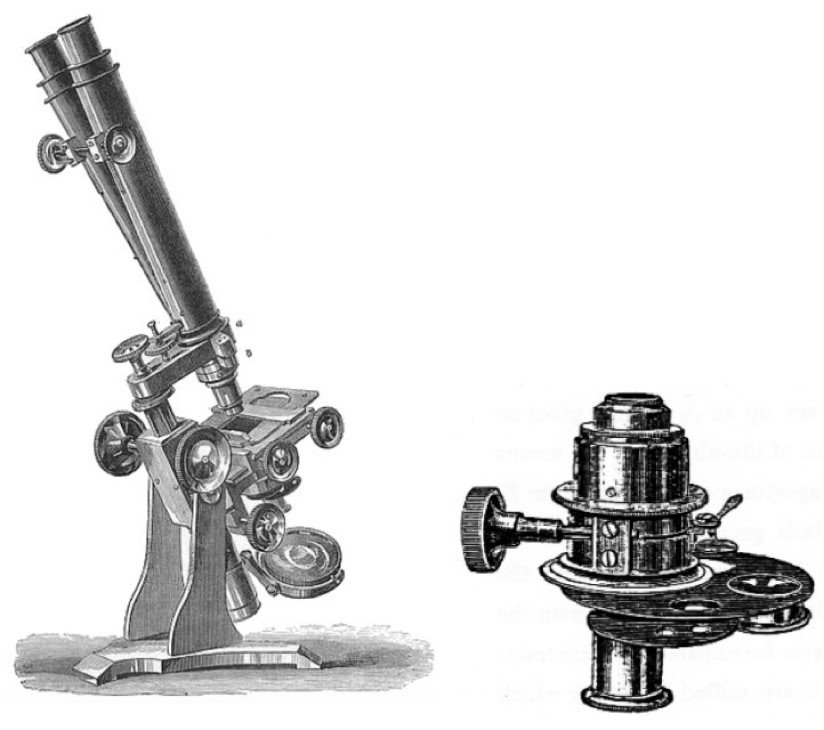
Figure 1. Binocular microscope for conventional and polarized light microscopy (left) and Swift’s popular achromatic condenser (right) as engraved in a James Swift’s catalogue of the 1870s.
James Swift was a London-based microscope-making firm founded in 1853 by James Powell Swift, the son of watchmaker Thomas Swift. The business was initially established at 15 Kingsland Road, London. Before setting up his own company, James Powell Swift had served an apprenticeship with the renowned microscope maker Andrew Ross. In 1870, the firm moved to 128 City Road, and subsequently, in 1872, to 43 University Street. In 1881, the firm introduced several improvements to microscope design, including the replacement of conventional straight rack-and-pinion focusing mechanisms with helical-cut components and the introduction of a new fine-focusing system. In 1884, James Powell Swift's son, Mansell James Swift, joined the business, which was subsequently renamed James Swift & Son. The following generation became involved in 1903, when the founder's grandson, Mansell Powell John Swift, joined the firm. James Powell Swift died in 1906. In 1912, the business was incorporated as a limited company under the name J. Swift Ltd. Both Mansell James Swift and Mansell Powell John Swift died in 1942. In 1946, the company was acquired by E. R. Watts & Son Ltd, largely reflecting the longstanding association between the Watts and Swift families. In 1949, John H. Basset joined the company and eventually took it over in 1968.