

Object 144
Macaura’s Pulsocon, blood circulator (late 1910s)
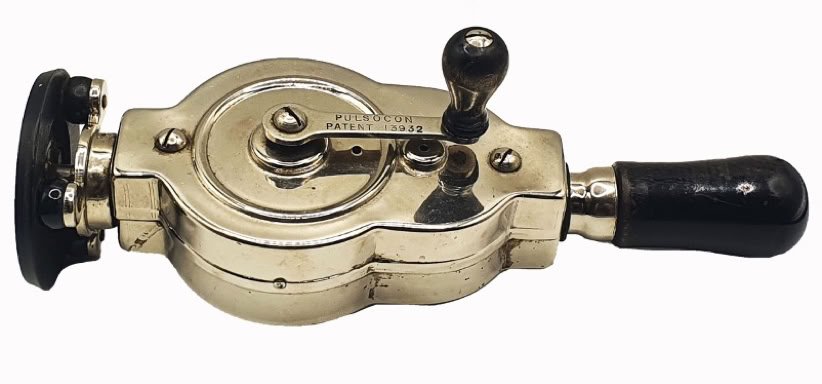
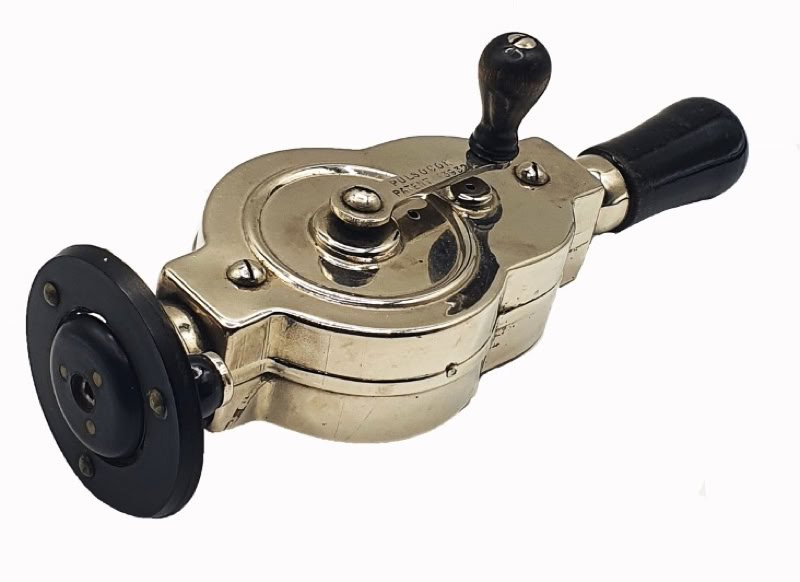
A ‘Macaura’s Pulsocon’, also known as the ‘Macaura Pulsocon hand vibrator’ or ‘Doctor Macaura’s blood circulator’. It is engraved with ‘PULSOCON, PATENT 13932’ and probably dates from the late 1910s. The cardboard box in which the instrument is housed is also marked ‘PATENT 13932’, ‘MACAURA’S PULSOCON’ and ‘The Appliances Manufacturing Company’.
The Pulsocon was invented by ‘Doctor’ Gerald Joseph Macaura (Figure 1). It was a vibrating massage device that enjoyed considerable commercial success in the late nineteenth and early twentieth centuries and was marketed in several countries, including England and France, where it was sold under the name ‘Pulsoconn’. Two different versions of the Pulsocon were produced. The first, believed to date from the 1890s and probably manufactured in the United States, bears patent number 1289 (Figure 2A). The second was covered by British patent number 13932, granted in 1905 (Figure 2B), and corresponds to the instrument in this collection. This version of the Pulsocon consists of two violin-shaped, chrome-plated half-casings, one fitted inside the other. The casings are topped by a vertical handle made of black-painted wood, with a crown-shaped tray beneath it. A rubber attachment, selected by the operator, fits into the central opening of the crown. The instrument was supplied with three interchangeable rubber attachments: a pear-shaped ‘Rubber plunger’, a ‘Bell plunger’ and a ‘Surger’, a brush-like attachment (Figure 3). Inside the casing, a mechanism comprising a large toothed wheel drives a smaller gear and a flywheel. Between the gear and the flywheel is a square-section component with rounded edges (Figure 4). A wheel mounted on a vertical axle is held against this component by a spring. This relatively simple mechanism converts the rotational movement of the crank into a rapid, reciprocating vertical movement of the rubber attachment. According to Macaura, the device could produce up to 6,000 vibrations per minute.
Macaura claimed that applying the vibrating attachment to an affected part of the body could improve blood circulation and treat a wide range of diseases and conditions, including infantile paralysis, gonorrhoea, deafness, early-stage cancer, tuberculosis, rheumatism, gout, asthma, impotence and haemorrhoids. These therapeutic claims, however, were not supported by reliable clinical evidence. The user manual supplied with the instruments can be consulted HERE.
Macaura was born in Ireland and later emigrated to the United States, returning to England in the early 1910s. He filed several patents for medical devices, including a patent for a blood circulator in the United States in 1902 and British patent number 13932 in 1905, which is the number engraved on this Pulsocon. In 1911, he entered into an arrangement with the Appliances Manufacturing Company of Leeds, England, which subsequently manufactured the device. Macaura was eventually exposed as a fraudster. In 1914, he was sentenced to three years' imprisonment in France for fraud, and it was revealed that he was not a qualified medical doctor. Despite this, he continued to market his vibrating devices, which remained commercially available well into the twentieth century.


Figure 1. Cover of a Pulsocon booklet from the early 20th century, showing a portrait of Gerald Macaura.
Figure 2. Cover of a Macaura’s Pulsocon user manual for the 1890s device bearing the patent number 1289 (left), and back cover of the user manual for the same device that was the subject of British patent number 13932 of 1905 (right).

Figure 3. Three types of rubber crushers that could be used with Macaura’s Pulsocon: the pear-shaped "Rubber plunger" (left), the "Bell plunger" (centre), and the brush-like "Surger" crusher (right).

Figure 4. Detail of the internal mechanism of the Pulsocon.