
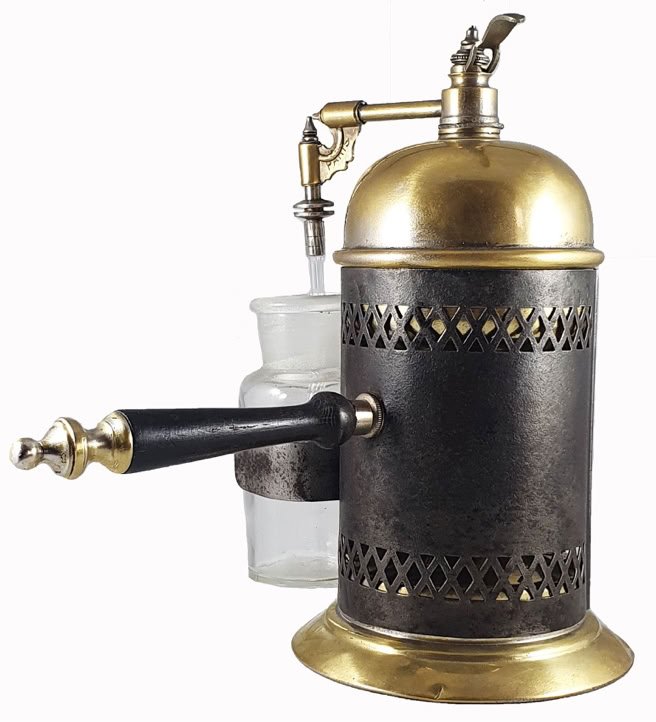


Object 90A
Steam generator Lucas Championnière-type (1920 – 1940)
A medical steam generator designed to produce an inhalable spray containing a mixture of water vapour and an active pharmaceutical ingredient. The resulting aerosol was intended for the administration of medication by inhalation or, potentially, for disinfection purposes. This example is heated by an alcohol lamp and should be dated to circa 1920–1940. The instrument is not marked with a maker's or retailer's name, although the word “PARIS” is engraved on it, suggesting a French origin. It is very similar to an instrument illustrated in the 1905, 1923 and 1931 catalogues of the French company Gentile (Paris), where it is described as a Pulvérisateur à vapeur pour inhalations (panel A in figure 1 below).
Lucas Championnière (1843–1913) travelled to Scotland in 1868, as a young medical student, to meet Joseph Lister. Lister had originally developed this type of sprayer for the disinfection of operating theatres before surgical procedures, using carbolic acid as the disinfectant (Figure 2). Championnière subsequently further developed the device and contributed to its use in medical practice.

Figure 1. Steam generators as engraved in the catalogues of several firms: (A, B) Gentile, Paris (1905, 1923 and 1931); (C) Duffaud & Cie (1934); (D) de la Croix (1925); (E, F) Simal (1931); (G) Lépine (1899).

Figure 2. Illustration of the use of carbolic acid spraying to disinfect surgeries before and during invasive medical interventions, as featured in the 1882 book “Antiseptic surgery: its principles, practices and results” by William Watson Cheyne.