
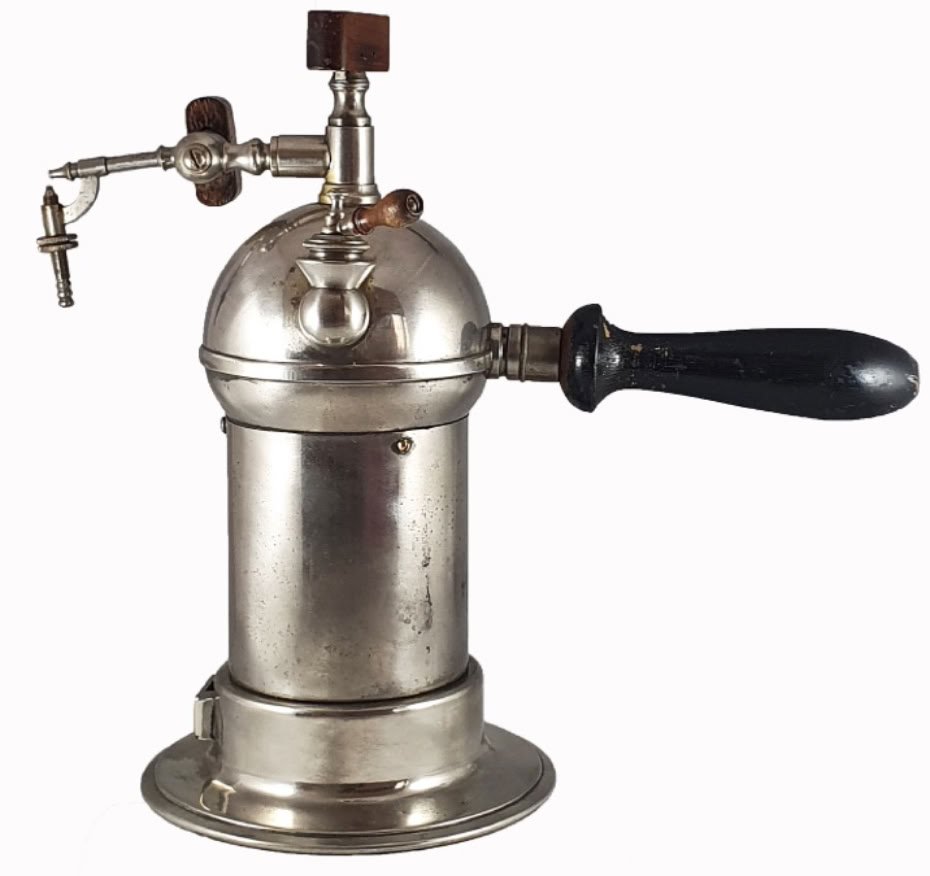

Object 90C
Steam generator Lucas Championnière-type (1920 – 1940)
A medical steam generator designed to produce an aerosol containing water vapour and an active pharmaceutical ingredient. The resulting spray was intended to be inhaled by patients for the administration of medication or, potentially, used for disinfection purposes. This example is electrically powered and should be dated to circa 1920–1940. It is engraved with the firm's name, “GENTILE”, and was therefore probably manufactured or retailed by this company.
An alcohol-burner-heated version of this instrument appears in Gentile's 1905, 1923 and 1931 catalogues, described as Pulvérisateur à vapeur de Lucas-Championnière, moyen modèle à deux becs, fonctionnant deux heures (panel B in figure 1 below). The 1931 catalogue also lists an electrically powered version. Identical electric models have been found in museum collections and online auctions bearing the names of other Parisian firms, including “Niédrée” and “Drapier et fils”. Similar instruments were manufactured and retailed by several other companies.
Lucas Championnière (1843–1913) travelled to Scotland in 1868, as a young medical student, to meet Joseph Lister. Lister originally developed this type of sprayer for disinfecting operating theatres before surgical procedures, using carbolic acid as the disinfectant (Figure 2). Championnière subsequently further developed the device and contributed to its application in medical practice.

Figure 1. Steam generators as engraved in the catalogues of several firms: (A, B) Gentile, Paris (1905, 1923 and 1931); (C) Duffaud & Cie (1934); (D) de la Croix (1925); (E, F) Simal (1931); (G) Lépine (1899).

Figure 2. Illustration of the use of carbolic acid spraying to disinfect surgeries before and during invasive medical interventions, as featured in the 1882 book “Antiseptic surgery: its principles, practices and results” by William Watson Cheyne.