


Object 92
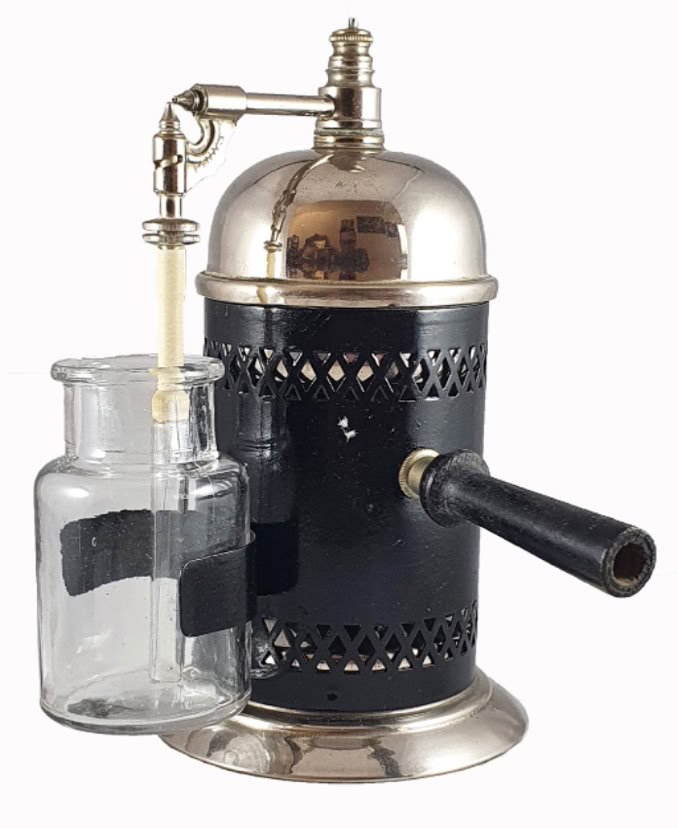
Steam generator Lucas Championnière-type (1920 – 1940)
Medical instrument designed to generate sprays consisting of water vapour mixed with an active pharmaceutical ingredient or other medicinal product. The resulting spray was inhaled by patients to administer the drug, although the device could also be used for disinfection purposes. The steam generator was heated using an alcohol lamp and should be dated to 1920–1940. Although the instrument is not marked with the name of a maker or retailer, its French origin is suggested by the engraved word ‘PARIS’. Nevertheless, it bears a strong resemblance to an instrument illustrated in the 1905, 1923 and 1931 catalogues of the French company Gentile (Paris), where it is described as a ‘Pulvérisateur à vapeur pour inhalations’ (panel A in the figure below).
Joseph Lister originally developed this type of sprayer for the disinfection of operating theatres and surgical sites before invasive medical procedures, using carbolic acid as the disinfectant (Figure 2). Lucas Championnière (1843–1913), who travelled to Scotland in 1868, as a young medical student, to meet Lister, subsequently further developed the device.

Figure 1. Steam generators as engraved in the catalogues of several firms: (A, B) Gentile, Paris (1905, 1923 and 1931); (C) Duffaud & Cie (1934); (D) de la Croix (1925); (E, F) Simal (1931); (G) Lépine (1899).

Figure 2. Illustration of the use of carbolic acid spraying to disinfect surgeries before and during invasive medical interventions, as featured in the 1882 book “Antiseptic surgery: its principles, practices and results” by William Watson Cheyne.