

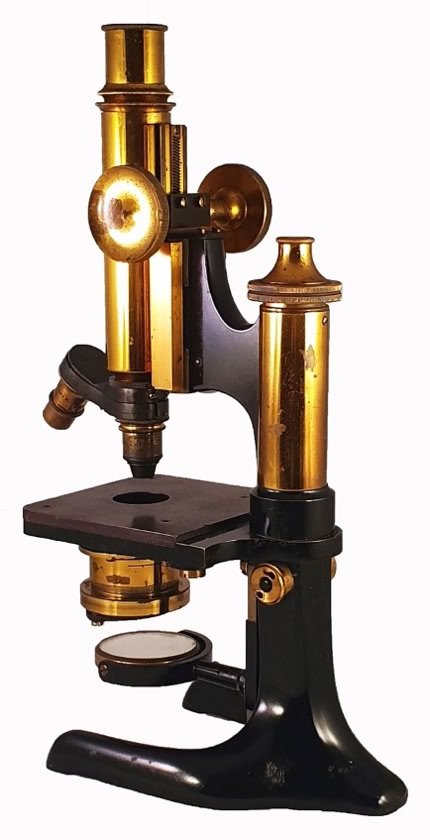


Microscope 109
(W. Watson & Sons; Praxis microscope; c. 1910)
W. Watson & Sons was a British firm of opticians and manufacturers of microscopes, cameras and other optical and scientific instruments, with trading premises in London and Edinburgh. The business was founded by William Watson in 1837 at 71 City Road, London, where it remained until 1861, when it relocated to 313 High Holborn. The company’s name changed to W. Watson & Son in 1867 and to W. Watson & Sons in 1882. In 1900, the firm acquired John Browning & Co., and in 1908 it became W. Watson & Sons Ltd. In 1929, the company exhibited at the British Industries Fair, where it was listed among the exhibitors of optical, scientific and photographic equipment. Its advertising highlighted the manufacture of microscopes for medical, industrial and educational applications. By the 1950s, the company had moved to 25 West End Lane, Barnet, Hertfordshire, where it remained until the late 1960s. In 1957, W. Watson & Sons was acquired by Pye of Cambridge, which was itself taken over by Philips in 1967. Microscope manufacturing under the Watson name had ceased by 1970.
Microscope 109 is a Watson instrument bearing the inscription ‘Watson & Sons Ltd, London’ and serial number 11974, which suggests a date of manufacture around 1910. The microscope's body is identical to that of the Praxis model illustrated in the company's 1912 catalogue (Figure 1), although the instrument has a different type of foot. The objectives and eyepieces are engraved ‘BOT. LAB. OXF.’, suggesting that the microscope was originally used by the Department of Botany at the University of Oxford. The original wooden case contains a panel engraved with the name ‘Deborah R. Clowes’. This may indicate a connection with Lionel Clowes (1921–2016), an emeritus reader at the University of Oxford who helped establish the concept of the quiescent centre in root apices in the early 1950s. The name appears to correspond to that of his daughter, Deborah Rosemary Clowes. Although this connection remains unconfirmed, the inscription provides a potentially valuable clue to the instrument's provenance.

Figure 1. Watson’s Praxis stand microscope as engraved in the 1912 edition of the Watson catalogue.