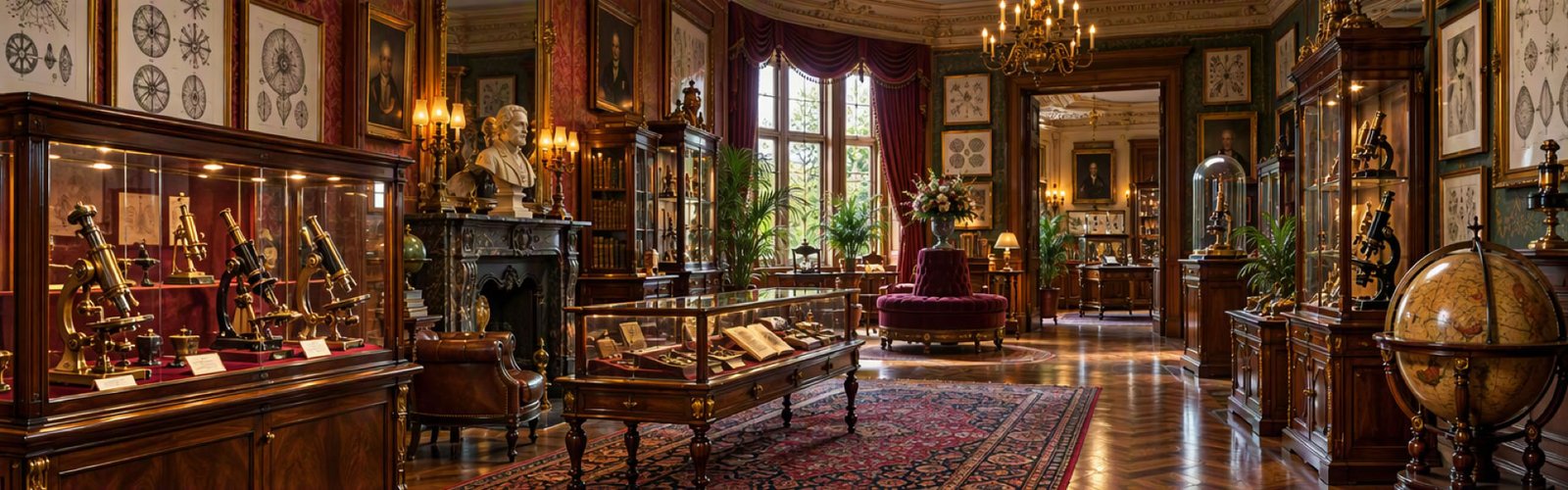
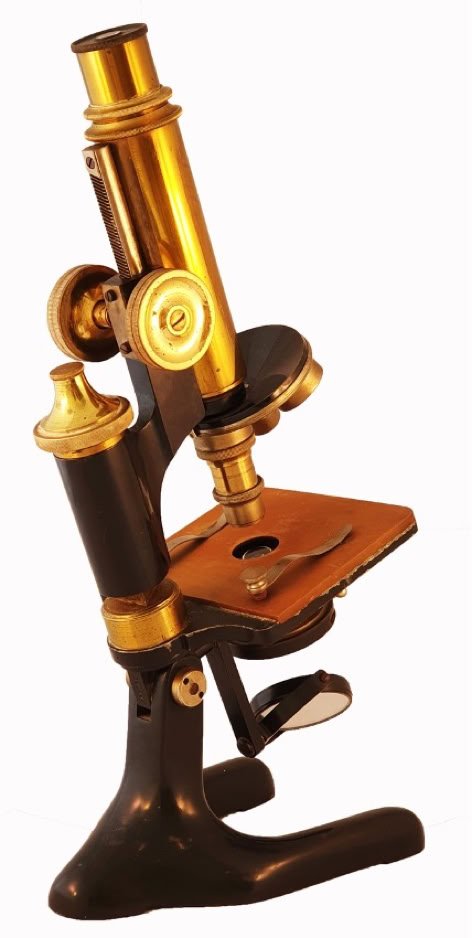
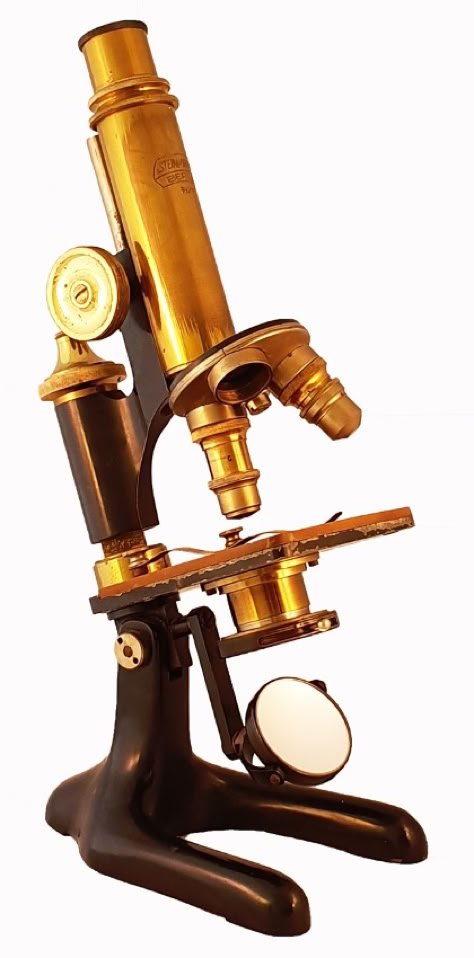
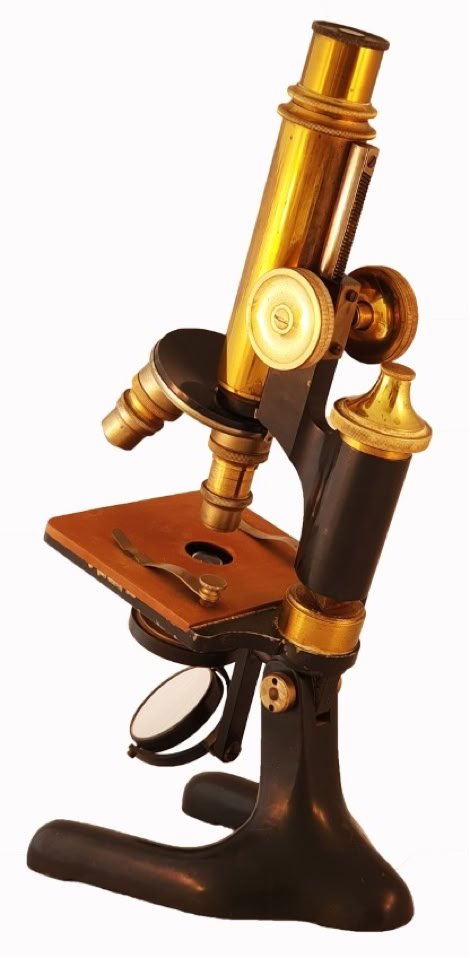
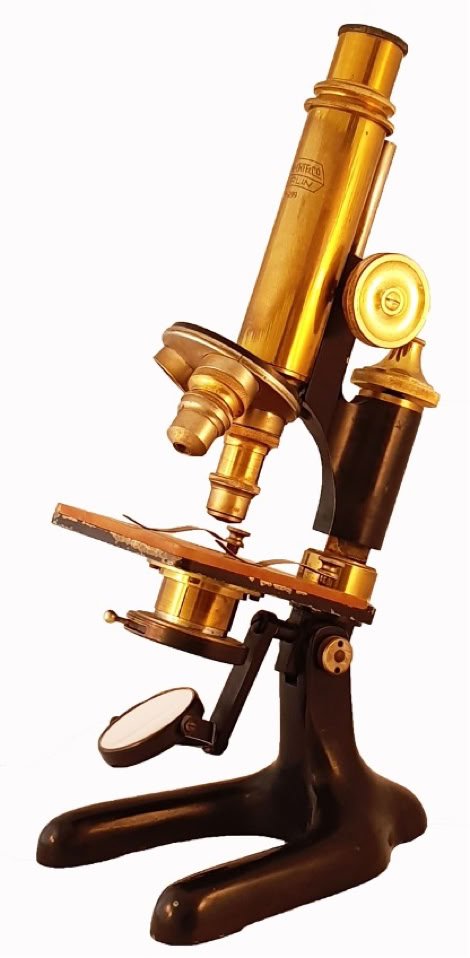
Microscope 110
(Steindorff & Co; stand E microscope; early 20th Century)
The mechanic Emil Steindorff began manufacturing scientific instruments in 1879, establishing his workshop on Reichenberger Straße in Berlin, Germany. By 1915, both Emil and Otto Steindorff, also a mechanic, were listed as owners of the business. In 1925, the firm's head office was located on Lindenstraße, Berlin, and the company traded as Steindorff & Co. Julius Kaiser, who subsequently became associated with the business as its owner, may have joined the firm around this time. By 1927, it was operating under the name Optisch Mechanische Fabrik Steindorff & Co., with its head office on Köpenicker Straße. In 1951, Steindorff of America Inc. was established in the United States to distribute the company's microscopes in the American market. The firm celebrated its 75th anniversary in 1954, when it employed approximately 80 people and its factory was located at Paul-Lincke-Ufer in Berlin. During the 1980s, the company traded as Optisch Mechanische Fabrik Steindorff & Co. GmbH, before declaring bankruptcy in 1986.
Microscope 110 bears the inscription ‘Steindorff & Co, Berlin’ and serial number 39299, suggesting a date of manufacture in the early twentieth century. The instrument is identified as a stand E microscope intended for students in a company catalogue dating from around 1920 (Figure 1). The microscope is preserved in its original wooden case, which bears a retailer's plaque inscribed ‘Frederick Robson & Co, Manufacturing Opticians, 46 Dean Street, Newcastle-on-Tyne’. This firm was probably the original British retailer of the instrument. Frederick Robson & Co. established its premises in Dean Street in 1867, initially concentrating on the manufacture of measuring instruments, including slide rules and barometers. In 1919, the business moved to Pilgrim Street, Newcastle upon Tyne, where it continued trading as an optical firm. The wooden case also bears the name ‘J. E. Francis’, possibly identifying a former owner of the microscope. Although the individual's identity has not been established, the inscription provides a useful clue to the instrument's history and provenance.
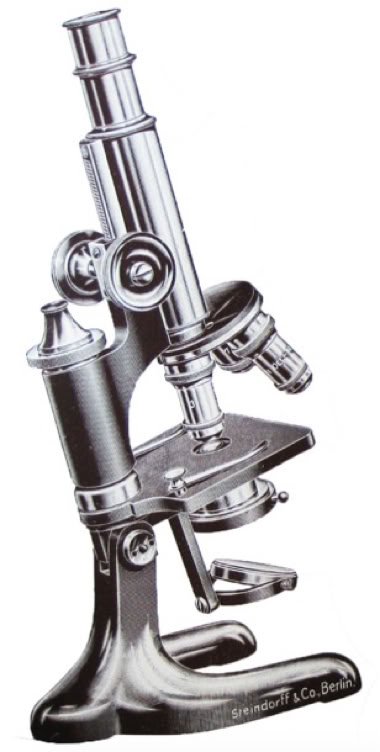
Figure 1. Steindorff microscope, stand E, as pictured in a firms’ catalogue from c. 1920.