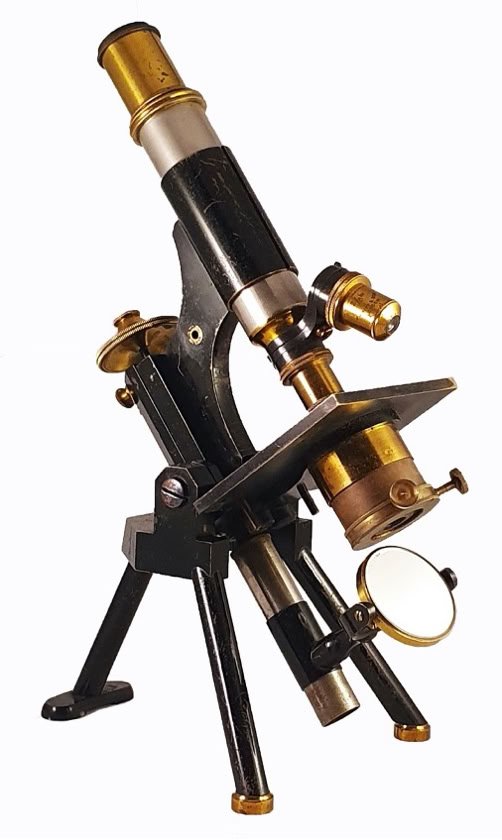
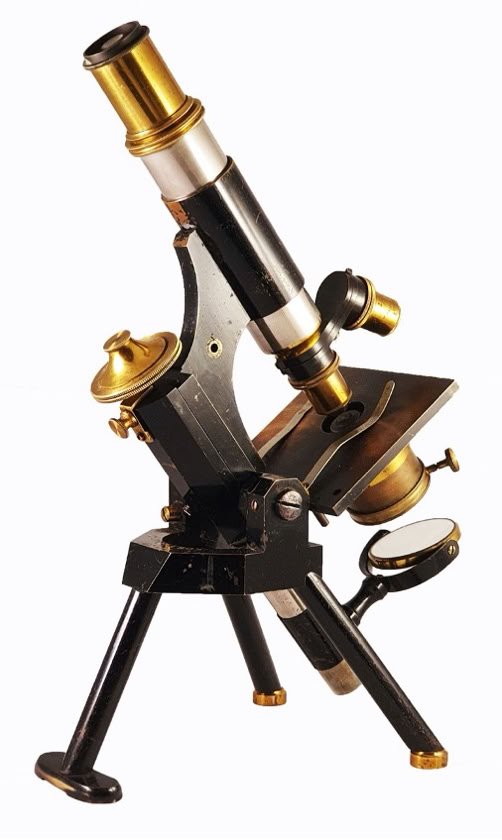
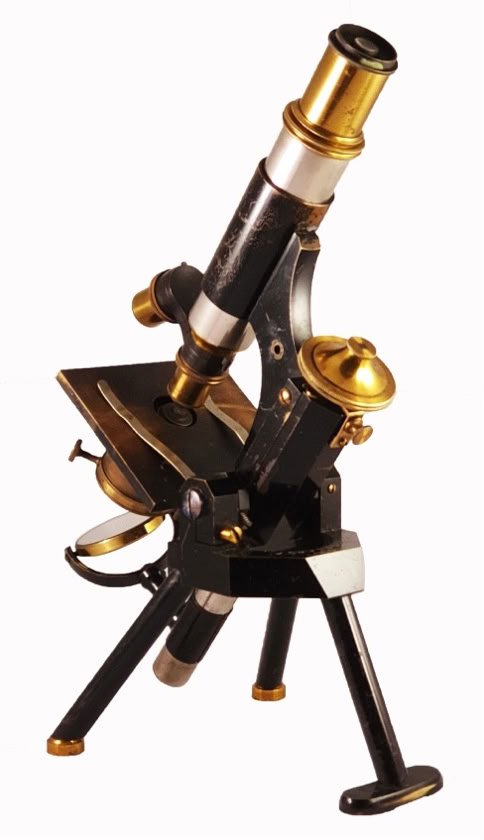
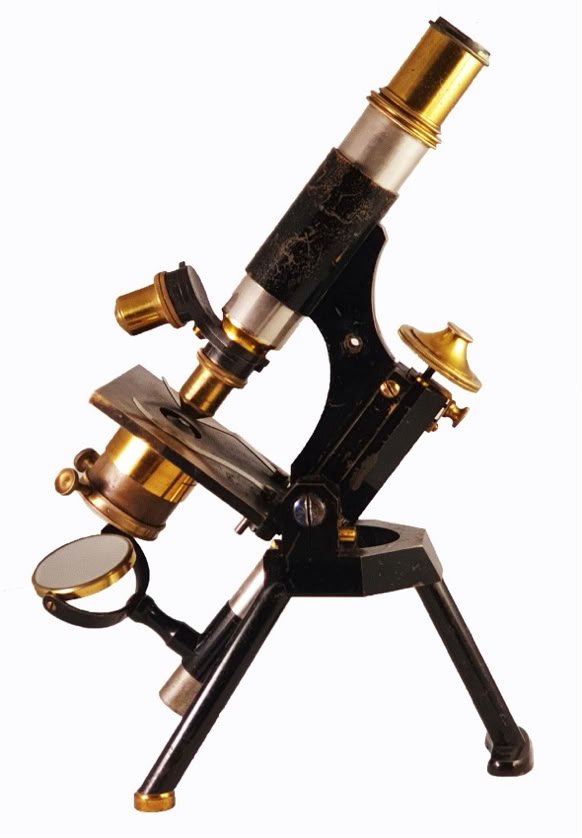
Microscope 150
(J Swift & Son; Histological and physiological microscope; c. 1900)
James Swift was a London-based microscope manufacturer whose business was founded in 1853 by James Powell Swift, the son of watchmaker Thomas Swift. Before establishing his own company, James Powell Swift served an apprenticeship under the renowned microscope maker Andrew Ross. In 1881, the firm introduced improvements to microscope design, including the replacement of the straight rack-and-pinion focusing mechanism with helical-cut components and the introduction of a new fine-focus system. In 1884, the founder's son, Mansell James Swift, joined the business, and the company name was changed to James Swift & Son. In 1901, Captain Robert Falcon Scott was supplied with Swift microscopes for use aboard the R.R.S. Discovery during the 1901–1904 expedition to Antarctica. These instruments included the model known in the firm's contemporary catalogue as the Discovery microscope. In 1903, Mansell Powell John Swift, the founder's grandson, joined the company. James Powell Swift died in 1906, and in 1912 the business was incorporated as a limited company under the name J. Swift Ltd. In 1942, both Mansell James Swift and Mansell Powell John Swift died. Four years later, E. R. Watts & Son Ltd acquired the company, partly owing to the longstanding connections between the Watts and Swift families. In 1949, the firm employed John H. Bassett, who took over the business in 1968.
Microscope 150, signed J. Swift & Son (London), is identified in the company's 1906 catalogue as a histological and physiological microscope (Figure 1). It was described as being specially designed to meet the needs of medical students and those engaged in general biological investigations. The instrument bears the serial number 11154, suggesting a date of manufacture around 1900.

Figure 1. The histological and physiological microscope model as pictured in a 1906 J. Swift & Son’s catalogue.