
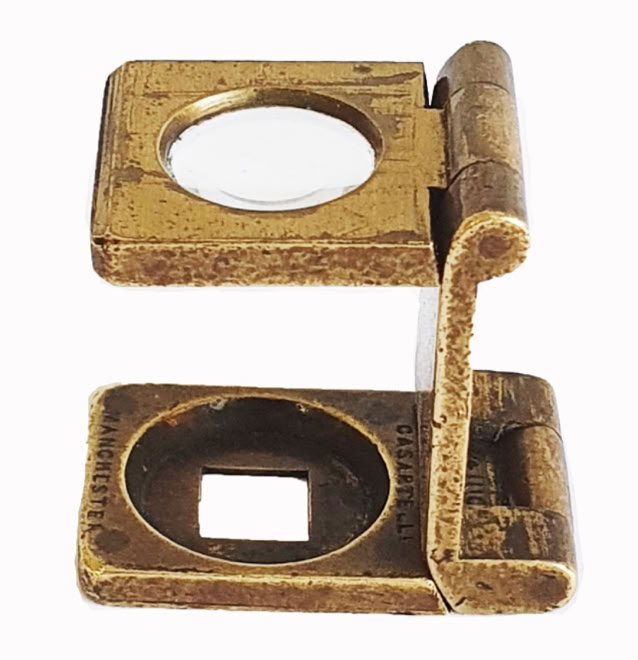
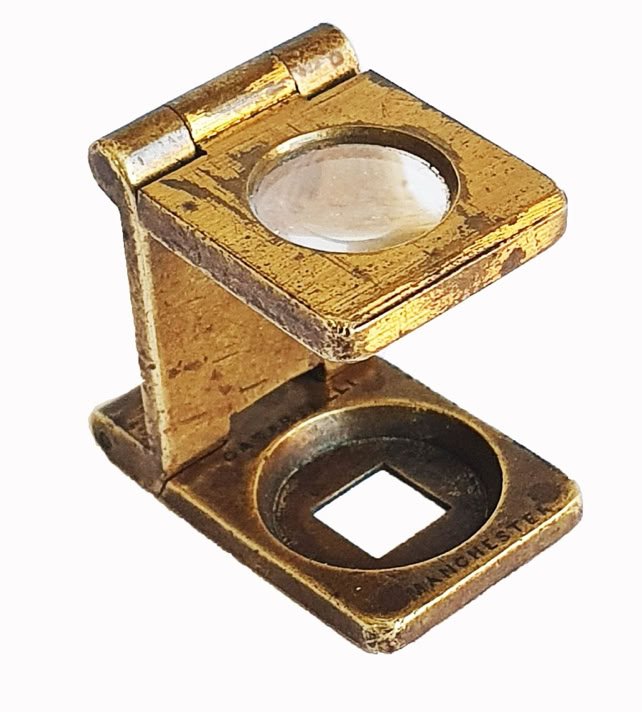
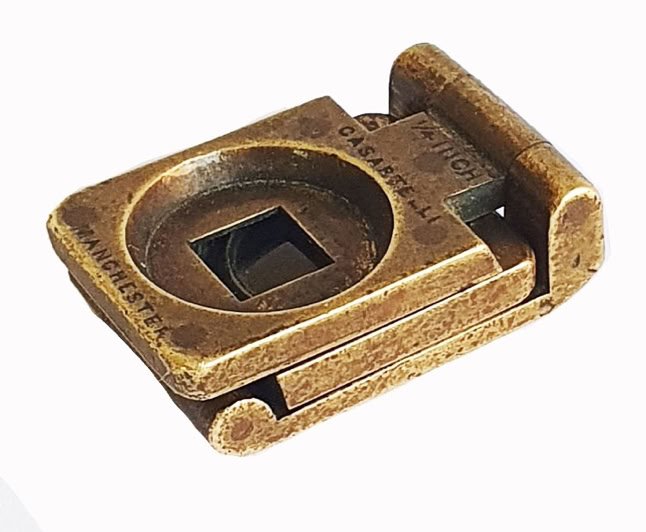
Microscope 250
(Casartelli; folding linen tester; late 19th century to the early 20th century)
Giuseppe Luigi Casartelli (1823–1900) emigrated from Italy to Liverpool, England, as a child, where he joined a relative’s scientific instrument business. He anglicised his name to Joseph Louis Casartelli and subsequently moved to Manchester, establishing himself as a manufacturer of optical equipment. For many years, his business operated from 43 Market Street. By around 1850, Casartelli was producing microscopes, telescopes and other optical instruments. During the 1870s and 1880s, however, the business increasingly focused on supplying Manchester’s heavy industries, manufacturing fittings for steam engines, mining equipment and optical instruments for the textile industry. One of Casartelli’s sons, Joseph Henry, became a partner, and in 1896 the business adopted the name J. Casartelli and Son. In 1922, the firm relocated to 18 Brown Street, Manchester, and in 1929 acquired the business of another family member in Liverpool. The company was liquidated in 1933, during the Great Depression. Parts of the business subsequently continued under different ownerships and names. The Liverpool branch traded as J. Casartelli & Son (Liverpool) and later became Casartelli Instruments Ltd. in 1984, closing in 1989. The original Manchester business continued as J. Casartelli & Son Ltd., subsequently becoming John Casartelli (M/c) Ltd. in 1939.
Microscope 250 is a folding linen tester, also known as a linen prover, engraved ‘CASARTELLI, MANCHESTER’. Dating from the late 19th or early 20th century, it was designed to count threads in woven fabrics. Thread count per unit of length was one of the criteria used to assess cloth quality, with finer, more closely woven fabrics generally commanding higher prices. These instruments fold flat for storage and transport and open into a C-shaped frame for use. Earlier examples typically had a simple, ungraduated viewing aperture in the base, whereas later versions incorporated calibrations to facilitate thread counting. Linen testers of this general design had been manufactured and sold by numerous companies since at least the early 19th century, and were rarely marked with the maker’s or retailer’s name (Figure 1).

Figure 1. Folding linen testers engraved in the catalogues of several companies: (A) Palmer (1840); (B) Negretti and Zambra (1859); (C, D) William McAllister (1867); (E, F) Negretti and Zambra (1870s e 1885); (G) James Queen (1870 and 1872); (H) Ernest Goldbacher (1879); (I) B. Kahn & Son (c. 1890); (J) Bausch and Lomb (1892); (K) Arthur Thomas (1914); (L) Bausch and Lomb (1914); (M) A. Clarkson & Co (1920s); (N) Emille Deyrolle (1931); and (O, P, Q) Gallenkamp (c. 1939)