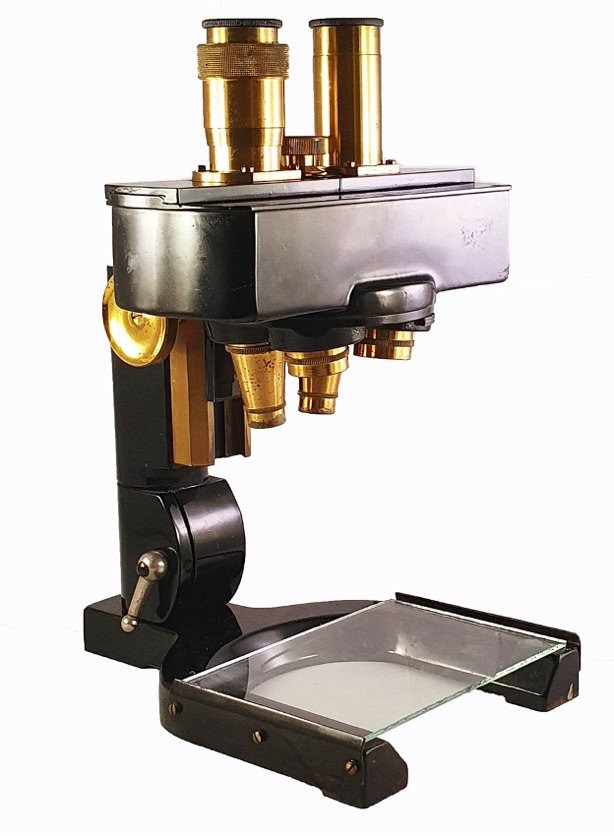
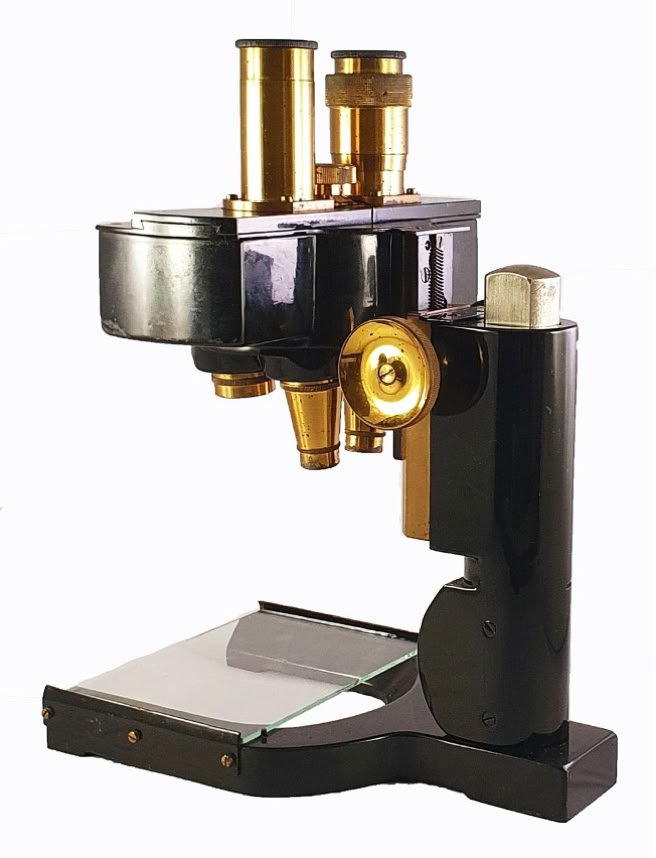
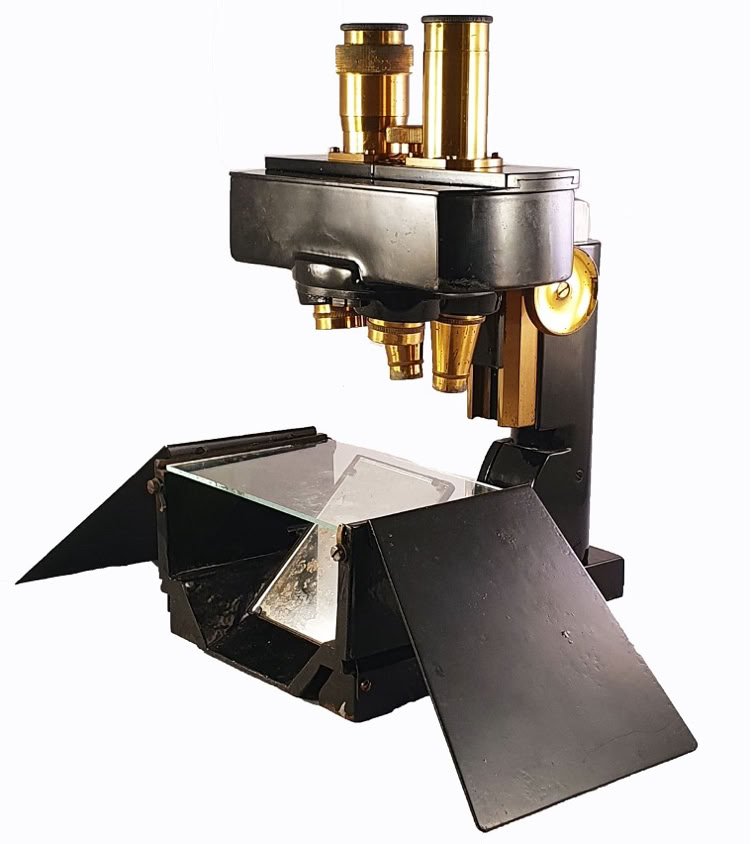
Microscope 274
(W. Watson & Sons; low-power binocular dissecting microscope; c. 1932)
W. Watson & Sons was a British firm of opticians and camera makers operating in London and Edinburgh. Founded by William Watson in 1837 at 71 City Road, London, the business remained at this address until 1861, when it moved to 313 High Holborn. The firm's name changed to W. Watson & Son in 1867 and subsequently to W. Watson & Sons in 1882. In 1900, the company acquired John Browning & Co., and in 1908 it became a limited company, W. Watson & Sons Ltd. The firm manufactured a wide range of optical, scientific and photographic equipment. An advertisement in the 1929 British Industries Fair Catalogue highlighted its microscopes for medical, industrial and educational applications. By the 1950s, the company had relocated to 25 West End Lane, Barnet, Hertfordshire, where it remained until the late 1960s. In 1957, it was acquired by Pye of Cambridge, which was itself taken over by Philips ten years later. Microscope manufacturing had ceased by 1970.
Microscope 274 is a Watson low-power binocular dissecting microscope, labelled ‘W. Watson & Sons, Ltd’. It bears the serial number 51522 and is dated to around 1932. The instrument is fitted with an accessory stage illustrated in the firm's 36th-edition catalogue (Figure 1). Watson described this microscope as ‘… designed to stand up to laboratory treatment in the hands of students’. It was intended for demonstration work and designed to be more robust than the original Greenough-pattern microscopes. The microscope also includes an auxiliary stage fitting that allows the use of transmitted illumination. This fitting slides into the dovetail guides provided for the glass stage originally supplied with the instrument.
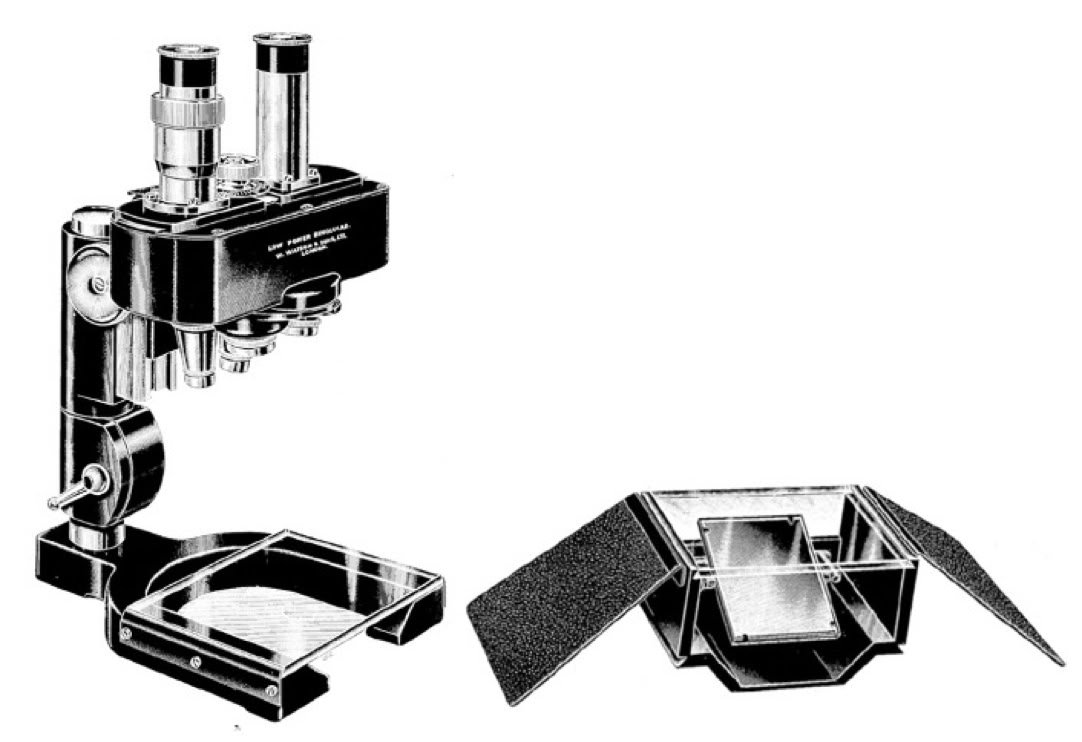
Figure 1. Watson’s low power binocular dissecting microscope (left) and accessory stage fitting (right), as engraved in the company’s 36th edition catalogue