
Microscope 285
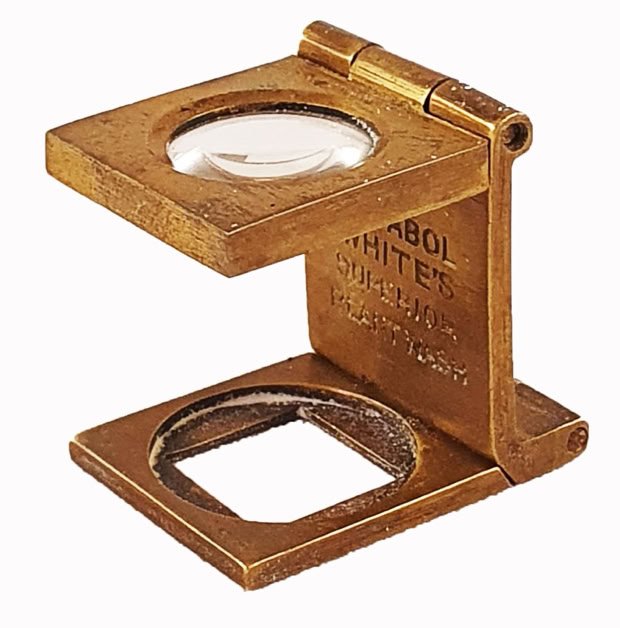
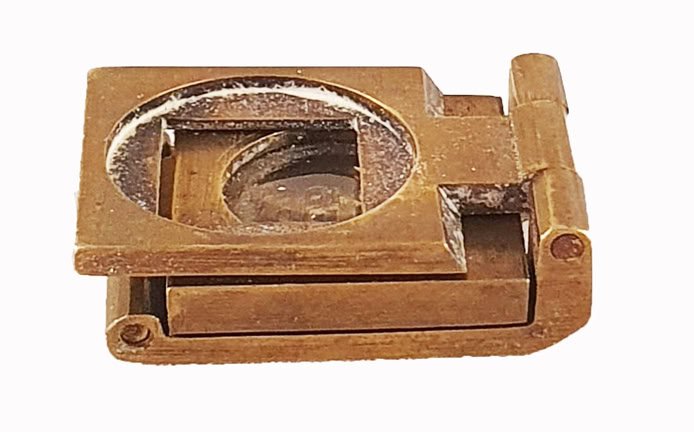
(E A White Limited; folding linen tester; early 20th century)
Edward Albert White Ltd. (E. A. White) was established in 1894 as a manufacturer of chemicals and insecticides for horticultural and agricultural use. The company was based in Paddock Wood, Kent, England. In 1898, the firm registered the trademark ‘ABOL’, and in 1900 it established ABOL Ltd. The product ‘Abol White’s Superior Insecticide’ was available by 1903, and the company continued trading into at least the 1920s.
Microscope 285 is a folding linen tester, also known as a linen prover, engraved with ‘E. A. White LimTD, Paddock Wood, Kent’ and ‘USE ABOL, WHITE’S SUPERIOR PLANT WASH’. The instrument can be dated to the early twentieth century. Linen testers were originally designed to count threads in woven fabrics, with the number of threads per unit of length serving as an indicator of fabric quality. They fold flat for storage and transport and form a C-shaped frame when opened for use. Early examples typically featured a simple viewing aperture in the base, while later versions sometimes incorporated calibrated scales to facilitate thread counting. Instruments of this type were manufactured and sold by numerous companies from at least the early nineteenth century onwards, although they were rarely marked with the name of their maker or retailer (Figure 1). The inscriptions on this example suggest that it may have been produced as a promotional item by E. A. White Ltd. to advertise its horticultural products, particularly ‘Abol, White’s Superior Plant Wash’. It may have been distributed to customers as a practical gift bearing the company's name and product branding.

Figure 1. Folding linen testers engraved in the catalogues of several companies: (A) Palmer (1840); (B) Negretti and Zambra (1859); (C, D) William McAllister (1867); (E, F) Negretti and Zambra (1870s e 1885); (G) James Queen (1870 and 1872); (H) Ernest Goldbacher (1879); (I) B. Kahn & Son (c. 1890); (J) Bausch and Lomb (1892); (K) Arthur Thomas (1914); (L) Bausch and Lomb (1914); (M) A. Clarkson & Co (1920s); (N) Emille Deyrolle (1931); and (O, P, Q) Gallenkamp (c. 1939)