

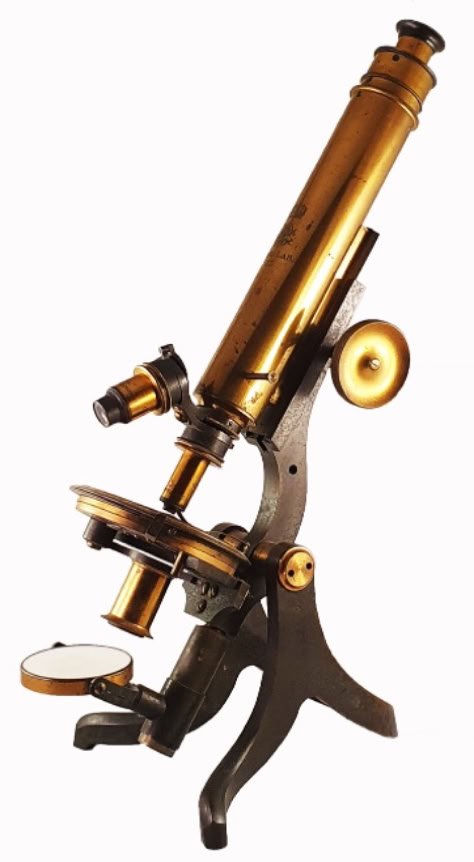
Microscope 293
(J Swift & Son; polarising microscope; c. 1880)
James Swift was a London-based microscope maker whose business was founded in 1853 by James Powell Swift, the son of watchmaker Thomas Swift. Before establishing his own company, James Powell Swift had served an apprenticeship with the renowned microscope maker Andrew Ross. In 1881, the firm introduced improvements to microscope design, including refinements to the rack-and-pinion focusing mechanism, the use of helical-cut components and a new fine-focusing system. In 1884, the founder's son, Mansell James Swift, joined the business, which subsequently traded as James Swift & Son. In 1901, the company supplied microscopes to Captain Robert Falcon Scott for use aboard the R.R.S. Discovery during the 1901–1904 expedition to Antarctica. These instruments were listed in contemporary catalogues as the Discovery model. In 1903, the founder's grandson, Mansell Powell John Swift, also joined the firm. James Powell Swift died in 1906. In 1912, the business was incorporated as a limited company under the name J. Swift Ltd. Both Mansell Powell and Mansell James died in 1942, and in 1946 the company was acquired by E. R. Watts & Son Ltd, partly reflecting the longstanding connections between the Watts and Swift families. In 1949, John H. Basset joined the company and subsequently took it over in 1968.
Microscope 293 is a polarising microscope manufactured by James Swift & Son, probably around 1880. The base is engraved ‘Swift & Son, University St, London, W. C.’, while the objective revolver bears the inscription ‘Swift, London, Registered’. The microscope tube is engraved ‘GEOL: LAB, 73’, accompanied by a crown and an unidentified logo. The rack normally associated with the body tube is missing.