

Microscope 36B
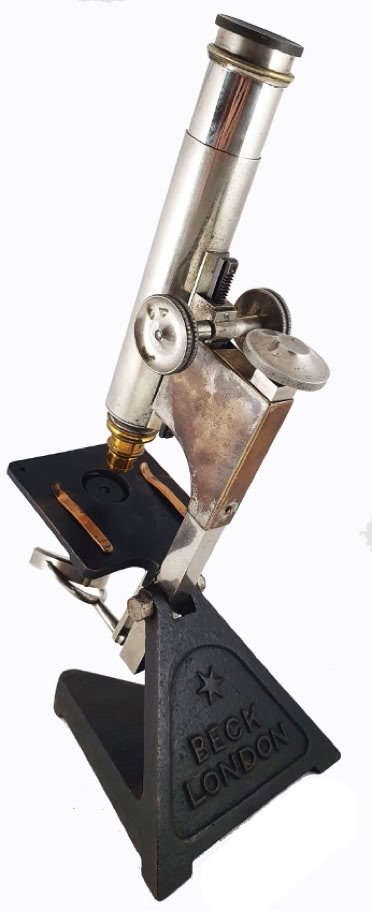
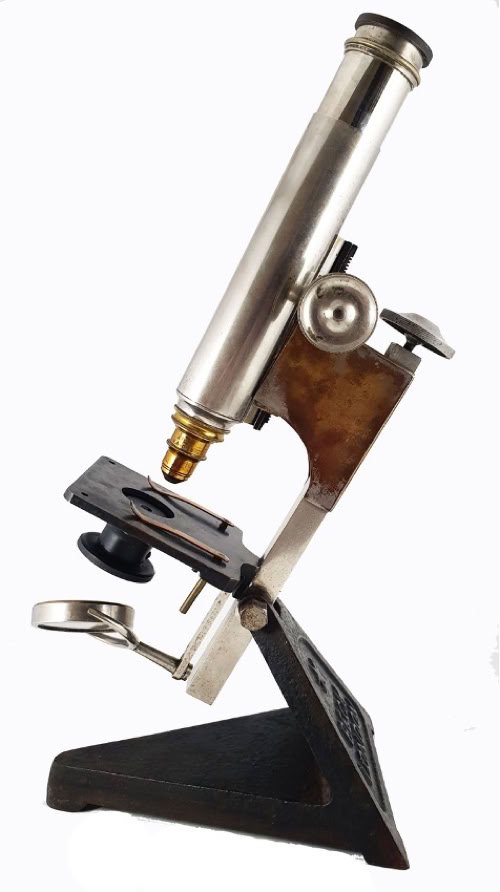
(R & J Beck; star microscope; c. 1885)
R & J Beck holds an important place in the history of British microscope manufacturing. The company's origins date to London in 1847, when James Smith (1800–1873) entered into partnership with Richard Beck (1827–1866), establishing Smith & Beck. Richard and his brother Joseph Beck were nephews of Joseph Jackson Lister, the British optician and physicist renowned for his work on achromatic lenses and his contributions to the development of the modern optical microscope. When Lister commissioned the construction of his improved microscope, he worked with James Smith, then an employee of the instrument-making firm of William Tulley, to produce the stand. Smith subsequently established his own optical instrument workshop in 1837. Through Lister's connections, Richard Beck began an apprenticeship with Smith in 1843. Following the establishment of their partnership in 1847, the company was renamed Smith, Beck and Beck in 1854, after Richard's brother Joseph, who had joined the business in 1851, became a partner. When Smith retired in 1865, the company adopted the name R & J Beck, which it retained for many decades. Following Richard Beck's premature death in 1866, aged just 39, Joseph continued to run the business. In 1895, the company became a limited company under the name R & J Beck Ltd. By 1968, it had become a subsidiary of the American Ealing Corporation. In 2019, Beck Optronic Solutions Ltd was identified as a successor to the former R & J Beck business.
Microscope 36B, dating from around 1885, is a Beck's Star model. This microscope was featured in the Journal of the Royal Microscopical Society in 1885, where it was presented as an effective instrument for scientific research (Figure 1). The microscope has a nickel-plated brass body mounted on a cast-iron base. Coarse focusing is achieved by a rack-and-pinion mechanism, while fine focusing is controlled by a knurled knob operating a micrometer screw. The substantial base allows the optical tube to be positioned horizontally, facilitating the use of a Wollaston camera lucida for drawing specimens under the microscope. The instrument was originally supplied with 1-inch and ¼-inch achromatic objectives. The serial number of the instrument Is 12778.

Figure 1. Beck’s Star model microscope, adapted from the Journal of the Royal Microscopical Society (June 1885).