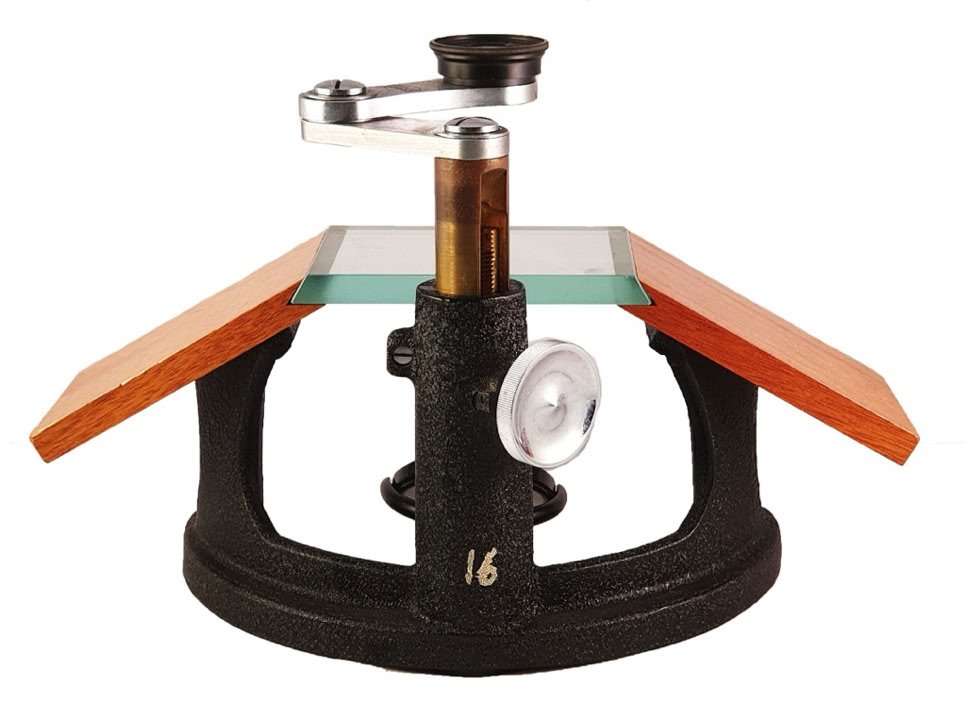

Microscope 74
(R&J Beck Ltd; Crescent dissecting microscope; c. 1935)
R & J Beck occupies an important place in the history of British microscope manufacturing. The company's origins date to 1847, when Richard Beck (1827–1866) entered into partnership with James Smith (1800–1873), establishing the firm of Smith & Beck in London. Richard and his brother Joseph Beck were nephews of Joseph Jackson Lister, the distinguished British optician and physicist renowned for his work on achromatic lenses and his contributions to the development of the optical microscope. Lister's association with James Smith began when he commissioned Smith, then an employee of the instrument-making firm of William Tulley, to manufacture the stand for his improved microscope. Smith subsequently established his own optical instrument workshop in 1837. Through Lister's influence, his nephew Richard Beck was apprenticed to Smith in 1843. Following the formation of their partnership in 1847, the company was renamed Smith, Beck & Beck in 1854, after Richard's brother Joseph, who had joined the business in 1851, became a partner. James Smith retired in 1865, and the firm adopted the name R & J Beck, under which it became widely known. Following Richard Beck's premature death in 1866, at the age of 39, Joseph continued to run the business. In 1895, the company was incorporated as R & J Beck Ltd. By 1968, it had become a subsidiary of the American Ealing Corporation. In 2019, Beck Optronic Solutions Ltd was identified as a successor to the former R & J Beck Ltd.
Microscope 74 is a Beck Crescent dissection microscope, dating from approximately 1935 (Figure 1).
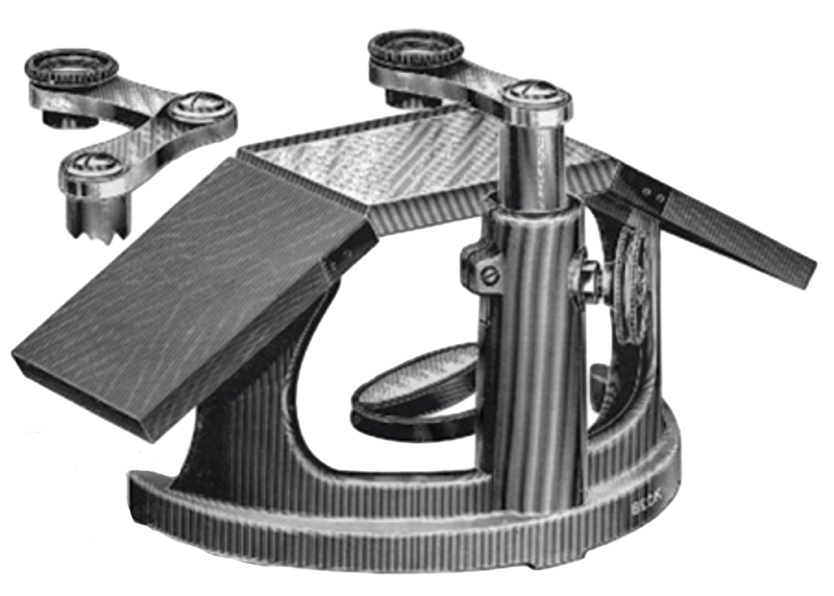
Figure 1. Beck’s Crescent dissection microscope as engraved in the company’s 1935 catalogue.