Microscope 82
(Paul Waechter; trichinoscope; 1920s)
Paul Waechter (1847–1893) trained as an optician and mechanic at the renowned Zeiss optical workshop in Jena, Germany. In 1872, he established his own optical workshop, and his early instruments were signed “Paul Waechter, Berlin”. Between 1872 and 1892, the firm produced more than 20,000 microscopes, primarily designed for the examination of meat for Trichinella larvae, the cause of trichinellosis (trichinosis). By 1890, Waechter had relocated his workshop to Friedenau, and instruments manufactured there were signed “Paul Waechter, Friedenau”. Following Waechter’s death in 1893, his long-standing assistant, Herr Puchler, took over the management of the business. Puchler subsequently entered into partnership with Paul Prasser, another master mechanic, and together they continued the firm into the early twentieth century under the name Optische Werkstätte Paul Waechter. The company’s microscopes frequently lacked signatures and serial numbers on the instruments themselves, with identifying marks instead appearing on the wooden cases supplied with them. Around the turn of the century, the firm relocated from Berlin to Potsdam, then part of the Prussian state of Germany. Instruments produced at this location were signed “Paul Waechter, Potsdam”. By the mid-1930s, the business had been taken over by the Pridat family. Operations appear to have been suspended during and immediately after the Second World War. In 1958, the company re-emerged with its registered office in Wetzlar, Germany. Microscopes manufactured during the 1960s and 1970s bore the signature “P. Waechter, Wetzlar”.
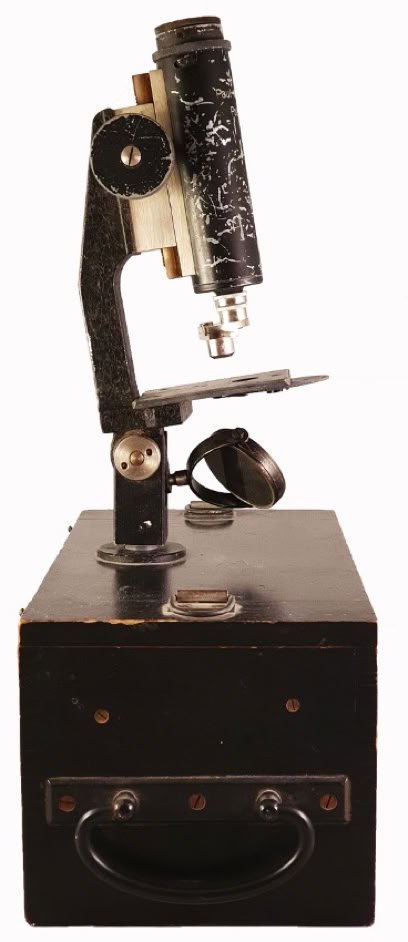
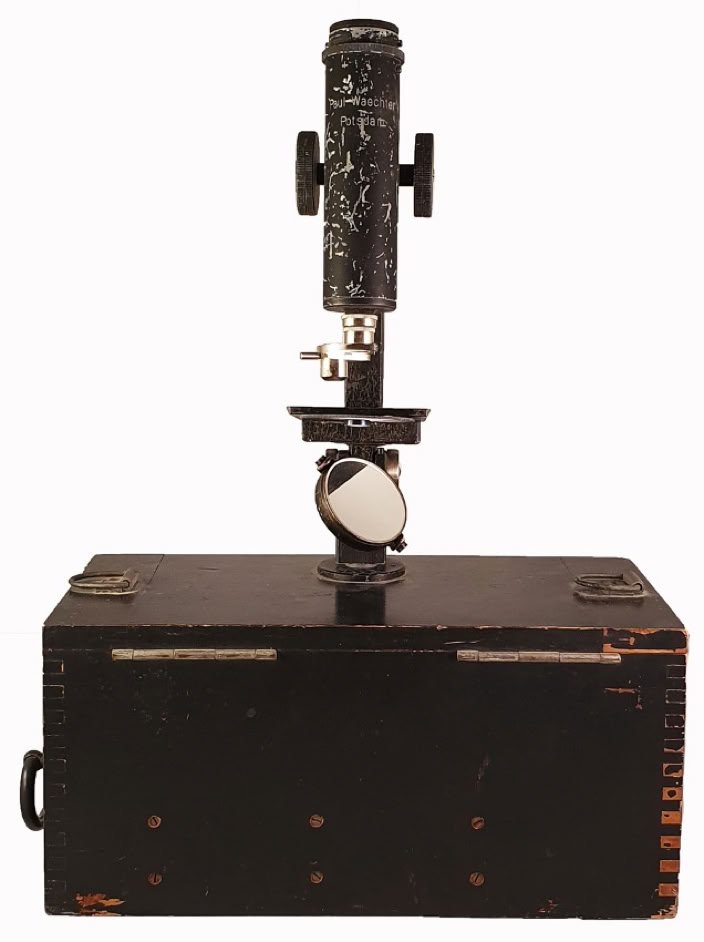
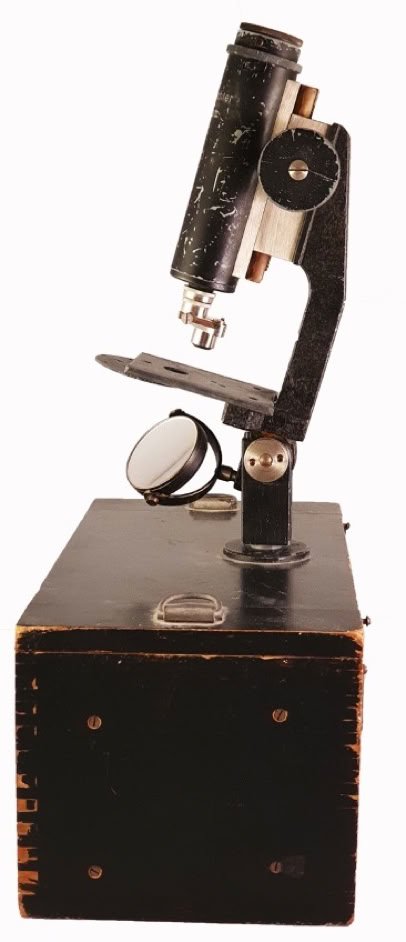
Microscope 82 is a trichinoscope bearing the signature “Paul Waechter, Potsdam”, dating it to the 1920s. Neither the instrument nor its wooden case bears a serial number. The microscope is mounted on top of its wooden storage case and features an unusually large rectangular stage plate. This was designed to accommodate a specialised, large, dual-plate glass compressorium used to examine pork samples for Trichinella larvae. Unfortunately, this distinctive accessory is missing from the present instrument.